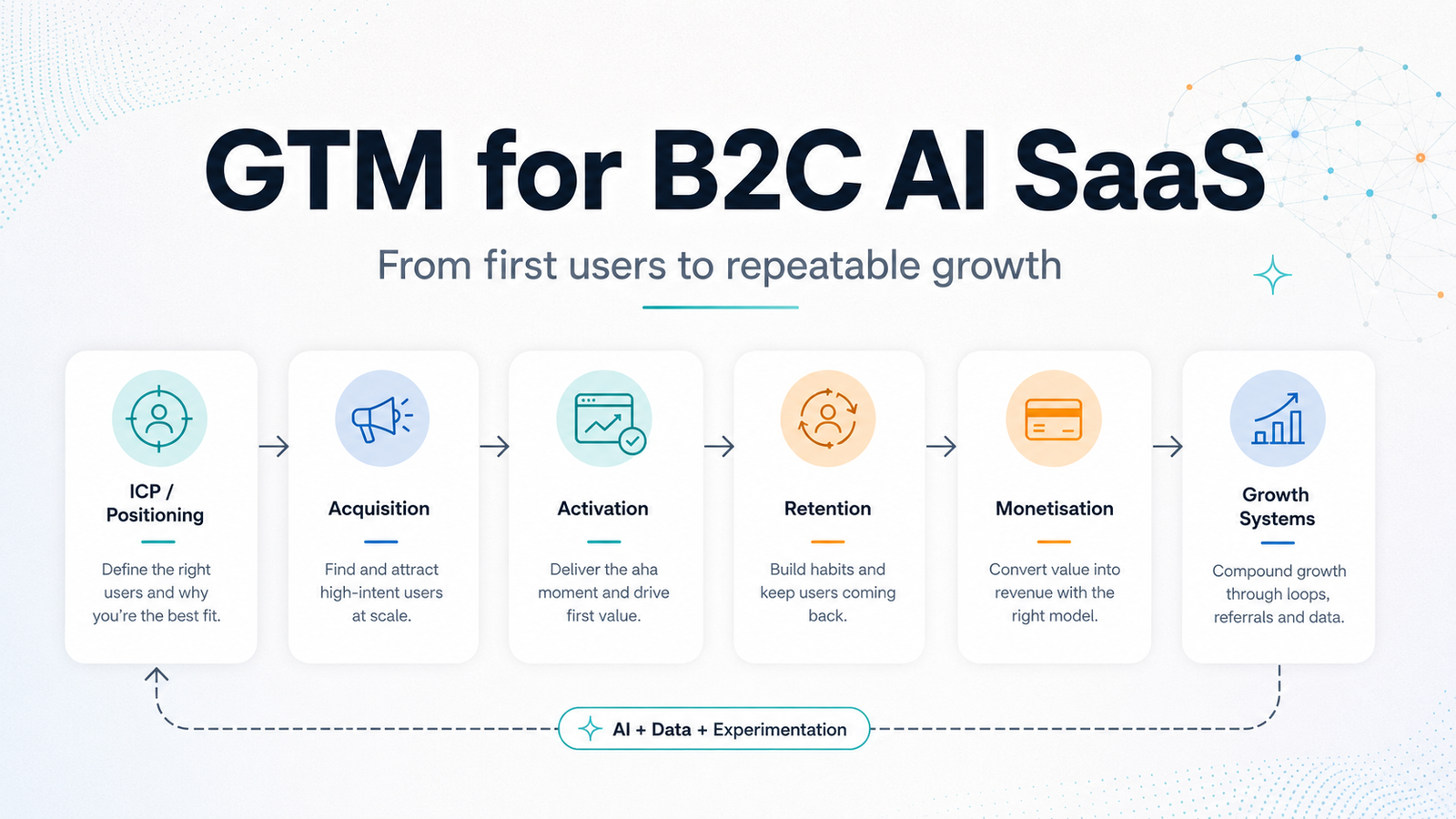

A B2C AI SaaS company can attract thousands of signups and still have no real go-to-market strategy.
The launch may perform well. A few creators may post about the product. The free tier may generate plenty of usage. Revenue may even begin moving in the right direction. But underneath those numbers, users may not be reaching value, retained users may be difficult to identify, acquisition may depend on occasional viral posts, and heavy users may cost more to serve than they pay.
This is the problem a proper GTM for B2C AI SaaS is meant to solve.
Your go-to-market strategy is not simply how you announce the product. It is the system connecting the right user, the right problem, the product experience, distribution, activation, monetisation, retention, and business economics.
What is a go-to-market strategy?
A go-to-market strategy is the set of decisions explaining how a product will reach a specific market, create value for that market, convert demand into usage or revenue, and develop a repeatable path to growth.
A conventional definition usually describes GTM as a plan for bringing a product to market, identifying the target audience, generating demand, and aligning the teams involved.
That definition is accurate, but it can sound too much like a launch plan.
For an early-stage SaaS company, GTM is better understood as a working hypothesis:
We believe this type of user has this important problem, will understand this promise, can be reached through these channels, will experience value through this product journey, and will pay enough for us to acquire and serve them sustainably.
Every part of that statement must eventually be tested.
A launch tells people that your product exists. A GTM strategy explains how the company expects to turn awareness into retained and profitable usage.
What is a SaaS go-to-market strategy?
A SaaS go-to-market strategy applies the same thinking to a recurring software business.
Unlike a one-time product sale, SaaS growth depends on what happens after the customer signs up. The company must repeatedly deliver enough value for the customer to continue using and paying for the product.
A SaaS GTM strategy therefore covers more than audience, messaging, and acquisition. It must also account for:
- Activation
- Onboarding
- Product usage
- Conversion
- Retention
- Expansion
- Churn
- Pricing and packaging
- Customer acquisition costs
- Cost of serving the user
The product experience is part of the go-to-market motion because it affects whether acquired users become active, retained, and paying customers.
What is a B2C SaaS GTM strategy?
A B2C SaaS GTM strategy explains how a software product will reach, convert, and retain individual consumers at scale.
In most B2C products, the user, decision-maker, and payer are either the same person or closely connected. There is usually no sales call, procurement process, implementation project, or annual contract negotiation.
That changes the job of GTM.
The product must communicate its value quickly. The user must understand what to do without extensive assistance. The price must feel justifiable without a salesperson building a return-on-investment case. Acquisition channels must produce enough volume, and the onboarding journey must turn that volume into meaningful usage.
This is why B2C GTM is usually more dependent on product-led onboarding, social discovery, creators, communities, app stores, search, referrals, paid acquisition, and lifecycle communication.
What is an AI SaaS GTM strategy?
An AI SaaS GTM strategy accounts for the fact that the product’s value, experience, and delivery costs are influenced by AI.
This creates several differences from traditional SaaS.
The output may not be equally good every time. Users may need to learn how to prompt or configure the product. A single poor result can damage trust. At the same time, every generation, model call, agent action, or processed file may create a real variable cost for the company.
Stripe notes that inference costs can vary significantly between customers, which makes flat pricing capable of subsidising heavy users while overcharging lighter ones.
An AI SaaS GTM strategy must therefore answer two questions simultaneously:
- How do we get users to experience useful AI output quickly?
- How do we deliver that output with sustainable economics?
A product that answers only the first question may grow usage while losing money. A product that answers only the second may protect margins while making the experience too restrictive to adopt.
GTM strategy versus marketing, growth, and business strategy
These strategies overlap, but they are not interchangeable.
| Strategy | The central question |
|---|---|
| Business strategy | Where will the company compete, how will it make money, and why can it win? |
| GTM strategy | How will the product reach, convert, monetise, and retain its chosen market? |
| Marketing strategy | How will the company create awareness, communicate value, and generate demand? |
| Growth strategy | How will the company systematically improve acquisition, activation, retention, revenue, and referrals? |
Marketing is one component of GTM. It may include positioning, content, creators, paid campaigns, search, partnerships, and brand.
Growth works across the entire customer journey. A growth team may change onboarding, pricing, referral mechanics, lifecycle messaging, or product features—not just promotional campaigns.
Business strategy sits above both. It includes decisions about the market, business model, competitive advantage, product direction, capital allocation, and long-term company structure.
GTM connects those decisions to the market.
B2B versus B2C SaaS GTM
The biggest difference between B2B and B2C SaaS GTM is not simply that one targets companies and the other targets consumers. The mechanics of the buying and usage journey are different.
A B2B SaaS company may need to convince several stakeholders, demonstrate measurable organisational value, pass security reviews, manage implementation, and support a sales cycle lasting weeks or months.
A B2C product may have only a few minutes to convince someone to sign up, grant permissions, upload a file, generate an output, and consider paying.
B2B GTM frequently relies on account selection, sales, outbound, demos, customer success, and expansion across a company.
B2C GTM more often relies on self-serve discovery, immediate product value, behavioural onboarding, lifecycle communication, subscription conversion, and repeat usage.
The mistake is copying a B2B SaaS playbook because most published SaaS advice is written for B2B companies. An ICP document, sales funnel, and outbound campaign will not solve a consumer AI product’s weak first-session experience.
Consumer SaaS versus prosumer SaaS GTM
A consumer product is usually purchased for a personal outcome. A prosumer product is used by an individual for work, income, craft, reputation, or professional productivity.
The boundary is not always clean.
An AI photo editor may be used casually by one person and commercially by a photographer. A writing assistant may help someone write personal emails while another user relies on it for client work.
Consumer GTM generally emphasises accessibility, enjoyment, convenience, emotional appeal, mobile behaviour, and a relatively low-friction purchase.
Prosumer GTM can support more specialised messaging, higher pricing, desktop workflows, templates, integrations, education, and creator-led distribution. The user may tolerate more complexity when the product helps them earn money or complete valuable work.
Some consumer AI products can also expand as individuals introduce them into professional workflows. A16z has described this consumer-to-workplace movement, alongside usage-based expansion, as an emerging source of revenue growth for certain AI products.
The important decision is not whether your company is permanently “consumer” or “prosumer.” It is which segment gives you the clearest initial path to repeated value.
Why AI SaaS companies need a different GTM approach
B2C AI SaaS combines the scale requirements of consumer software with the cost and reliability challenges of AI.
First, AI can create curiosity before it creates a habit. People may sign up because a demo looks impressive, generate something once, and never find a reason to return.
Second, free usage is not necessarily free for the company. An overly generous plan may attract users who repeatedly consume expensive features without developing any willingness to pay.
Third, AI quality affects activation. In an analysis of first-time users of Amplitude’s Global Agent, users with a strictly positive first-week experience retained substantially better than those who encountered an early failure signal. The result came from Amplitude’s own product and should not be treated as a universal benchmark, but it illustrates how strongly an early AI outcome can shape adoption.
Finally, early monetisation can conceal weak long-term value. RevenueCat’s 2026 subscription-app dataset found that AI apps converted and monetised downloads more effectively at the median, but retained fewer subscribers after 12 months and produced higher refund rates than non-AI apps. The dataset covers in-app subscription businesses rather than every AI SaaS model, but the strategic warning is useful: strong initial conversion does not prove durable demand.
For AI companies, GTM must be built around useful repetition—not just impressive generation.
What should a B2C AI SaaS GTM strategy include?
A useful strategy should make eight connected decisions.
1. A narrow initial user
Define the user by situation, problem, current behaviour, and desired outcome.
“Content creators” is too broad. “YouTube educators who publish weekly and need short clips from long videos” gives the company something it can design and distribute around.
2. A clear problem and promise
Explain what becomes easier, faster, cheaper, or newly possible.
Avoid positioning the product around the underlying model. Most users do not want generative AI. They want a result that generative AI can help produce.
3. A fast path to value
Decide what the user must accomplish during the first session.
This could be generating a usable output, improving an existing asset, completing a workflow, or saving meaningful time. The onboarding journey should move users toward this outcome rather than merely introducing features.
4. A primary acquisition wedge
Choose one initial way of reaching the market.
That may be creator demonstrations, search, communities, product virality, app-store discovery, paid social, partnerships, or founder-led content.
The goal is not to find every channel immediately. It is to understand why one defined group responds to one repeatable message in one reachable environment.
5. An activation and habit model
Define what activated behaviour looks like and why the user should return.
A user generating one image may not be activated. A user creating a project, saving a preferred style, exporting an asset, and returning for the next campaign may be much closer.
6. A monetisation model
Choose what users pay for and how pricing relates to value and cost.
Options include subscriptions, credit packs, usage-based pricing, paid exports, premium capabilities, or hybrid plans.
Usage-based pricing can align payment with consumption, but it can also create unpredictable bills, discourage usage, and require accurate metering. Hybrid pricing can provide a recurring revenue floor while charging heavy users for additional consumption.
7. A retention system
Identify the recurring trigger that brings the user back.
The trigger may be a weekly workflow, new input, ongoing project, saved context, collaboration, content calendar, personal progress, or replenishing need.
Without a recurring trigger, the product may be useful without becoming a recurring SaaS business.
8. Measurement and learning
Connect acquisition source, user behaviour, revenue, and cost.
A GTM strategy is not complete because these decisions appear in a document. It becomes useful when the team can observe where its assumptions are correct and where the system breaks.
The main GTM models for B2C AI SaaS
Most companies use a combination of models, but one should usually act as the initial wedge.
Product-led GTM
The product itself drives much of acquisition, activation, conversion, and retention. OpenView describes product-led growth as a GTM strategy that places the product at the centre of the customer journey.
It fits products that can demonstrate value quickly without extensive setup. Its limitation is that a free product experience does not automatically create distribution or retention.
Creator- and community-led GTM
Creators demonstrate the product inside an existing workflow and transfer trust to it.
This is effective for products with visible outputs, specialised communities, or use cases that require education. Its weakness is dependence on individual creators and irregular campaign performance unless the company develops a repeatable system.
Search- and intent-led GTM
The company captures users already searching for a problem, workflow, comparison, template, or alternative.
This fits established problem categories. It is less effective when users do not yet know how to describe the problem or search for the product category.
Performance-led GTM
Paid acquisition sends users directly into a measurable conversion journey.
This can scale when activation, conversion, retention, and contribution margins are already understood. Used too early, it pays to amplify a leaking funnel.
Prosumer-led or hybrid GTM
The company initially targets individual professionals and later expands monetisation through heavier usage, collaboration, teams, or business plans.
This model suits products that start as self-serve utilities but become more valuable when embedded in professional work.
How should an early-stage founder apply GTM?
Start manually.
Before automating onboarding, personally observe users attempting the core workflow. Before scaling creators, learn which demonstrations attract retained users. Before buying traffic, determine whether acquired users reach value. Before hiring a large growth team, understand which problem that team is supposed to scale.
A practical sequence looks like this:
- Select one initial user and one urgent use case.
- Interview and observe users until repeated language and behaviour begin appearing.
- Recruit the first users manually through communities, personal outreach, content, or partnerships.
- Watch their first product session.
- Define the activation event and expected usage frequency.
- Instrument the journey from source to activation, payment, retention, and cost.
- Test one primary acquisition wedge.
- Improve the product journey before increasing acquisition volume.
- Test pricing with real users rather than relying only on surveys.
- Document what repeatedly works and remove the founder-only workarounds.
Experiments should generate learning, not merely activity. A useful growth process gathers customer and product inputs, selects a focused hypothesis, runs the test, and documents what changed.
Who owns GTM in an early-stage startup?
The founders own GTM until the company understands enough of the motion to delegate parts of it.
Marketing may own acquisition campaigns. Product may own activation. Growth may run experiments. Engineering may own instrumentation and cost controls. Customer support may reveal retention problems.
But someone must connect the entire system.
At the beginning, that person is usually a founder because the decisions affect the product, market, business model, positioning, and company direction. First Round’s guidance for early founders similarly emphasises that founders eventually have to move beyond building the product and turn their attention toward the market.
Hiring a Head of Growth does not remove the founder’s responsibility to understand the user and market.
When should a startup begin planning GTM?
GTM planning should begin before the product is finished.
You do not need a polished strategy deck before building an MVP. You do need hypotheses about the user, problem, promise, distribution, and path to value.
Early GTM work can influence what is built, which workflow receives priority, what data is captured, how onboarding works, and whether the product is designed for sharing or repeated use.
Waiting until launch frequently produces a finished product with no clear audience, weak positioning, and no dependable way of reaching users.
How long does it take to build a repeatable GTM motion?
There is no reliable universal timeline.
A repeatable motion exists when the company can repeatedly acquire a defined type of user through a recognisable process and produce reasonably consistent activation, retention, revenue, and unit economics.
You should see the pattern across several cohorts, not one launch.
The motion should also work without constant founder heroics. If every conversion depends on a founder personally explaining the product, rebuilding the campaign, or manually rescuing the user, the company has discovered demand but has not yet built repeatability.
A viral spike is an event. A repeatable GTM motion is a system.
Common B2C AI SaaS GTM mistakes
Treating GTM as a launch campaign
A strong launch can create awareness, but it does not establish retention, monetisation, or scalable distribution. The team celebrates signups while ignoring what those users do next.
Targeting everyone interested in AI
Interest in AI is not an ICP. It does not explain the user’s situation, urgency, existing workflow, willingness to pay, or expected frequency of use.
Optimising signups instead of useful outcomes
Removing every signup barrier can increase registrations while lowering user quality. The goal is not the cheapest possible signup. It is acquiring people likely to experience recurring value.
Using the free tier without an economic purpose
A free tier should help users understand value, support distribution, or segment future buyers. It should not provide unlimited expensive usage simply because competitors do.
Scaling paid acquisition before retention
Paid channels can temporarily make growth charts look healthier. If users do not activate and return, the company is purchasing churn.
Copying competitor pricing
Competitors may have different inference costs, funding, user segments, retention, or strategic goals. Their price is evidence about the market, not an answer for your company.
Hiring growth leadership before defining the problem
A growth hire can accelerate learning and execution, but cannot compensate for an undefined user, unclear value proposition, or unreliable product outcome.
Tracking revenue without contribution economics
ARR can rise while inference, creator fees, paid acquisition, refunds, and support costs consume the value created. Growth should be evaluated after the cost of acquiring and serving the user.
How can you tell whether the GTM strategy is working?
Surface-level metrics include:
- Website traffic
- Followers
- Downloads
- Waitlist registrations
- Total signups
- Launch engagement
- Gross revenue
These metrics can help explain reach, but they do not prove the GTM system works.
More meaningful signals include:
- Qualified users acquired by channel
- Activation rate
- Time to first value
- Successful first-session outcome
- Return behaviour at the product’s natural frequency
- Retention by acquisition source and use case
- Free-to-paid or trial-to-paid conversion
- Revenue and gross profit per payer
- Inference cost per active and paying user
- Refund, cancellation, and payment-failure rates
- Percentage of users becoming power users
- Customer acquisition payback
- Contribution margin by channel and plan
Do not judge these metrics independently.
A channel with expensive acquisition may still be valuable if it produces high-retention users. A free plan with low conversion may be useful if it generates organic distribution. A high-priced plan may appear attractive until refund rates and service costs are considered.
The purpose of the metrics is to explain the quality of growth, not simply its quantity.
A practical B2C AI SaaS GTM example
Imagine an AI product that converts long videos into short clips.
The broad GTM approach might target “content creators,” offer free credits, launch on Product Hunt, sponsor several general technology creators, and run ads promising that users can create content ten times faster.
This may generate a large signup spike. But the users include podcasters, agencies, students, meme pages, businesses, and people experimenting with AI. Their workflows, willingness to pay, and quality expectations are completely different.
A more focused GTM could initially target YouTube educators who publish one long video every week and need several clips for LinkedIn, Instagram, and YouTube Shorts.
The product promise becomes specific: turn one weekly educational video into five publishable clips without reviewing the entire recording.
Creator partnerships can demonstrate the exact workflow. Onboarding can ask for the video and preferred clip format immediately. Activation can be defined as exporting a usable clip. Retention can be measured around the creator’s weekly publishing cycle.
Pricing can include a monthly allowance that covers the typical workflow, followed by additional credits for heavier usage.
The narrower approach may initially attract fewer signups. But it gives the company a better chance of learning why users activate, return, and pay.
That learning can later support expansion into podcasts, agencies, webinars, and other creator segments.
Final takeaway
A strong GTM for B2C AI SaaS does not begin with a list of marketing channels. It begins with a connected theory of how a specific user will discover the product, experience value, return, pay, and remain economically valuable to the company.
At the beginning, most parts of that theory will be assumptions.
The founder’s job is to test them in the correct order: user and problem first, then value and activation, followed by retention, monetisation, acquisition, and scale.
Until those pieces begin reinforcing one another, you do not have a repeatable GTM motion. You have a collection of growth activities.
10. FAQs
Is a GTM strategy the same as a product launch?
No. A launch is a time-bound event used to introduce or promote a product. GTM is the broader system through which the product reaches, activates, converts, monetises, and retains its target market.
Can a startup build its GTM strategy before product-market fit?
Yes. Early GTM is a set of hypotheses used to search for product-market fit. The strategy should remain flexible as the company learns which users, problems, messages, and workflows produce the strongest response.
What is the best GTM channel for B2C AI SaaS?
There is no universally best channel. The right channel depends on where the target user discovers products, whether the use case is already being searched for, how easily the product can be demonstrated, and whether the channel produces retained rather than merely curious users.
Should a B2C AI product use freemium or a free trial?
Freemium works when ongoing free usage supports discovery, collaboration, sharing, or a clear upgrade path. A free trial works when users can experience meaningful value within a limited period. Both can fail when the limits are unrelated to value or the free experience attracts expensive, low-intent usage.
When should a startup hire its first Head of Growth?
Hiring becomes more useful when the company has early evidence of demand, a measurable customer journey, sufficient product reliability, and specific growth constraints to solve. Hiring someone to “find growth” before these foundations exist often creates unfocused experimentation.
How long should a startup test a GTM strategy before changing it?
Test long enough to observe the behaviour the strategy is supposed to produce. Acquisition messages can be evaluated relatively quickly, while retention may require several natural usage cycles. Change individual assumptions based on evidence rather than replacing the entire strategy after one weak campaign.